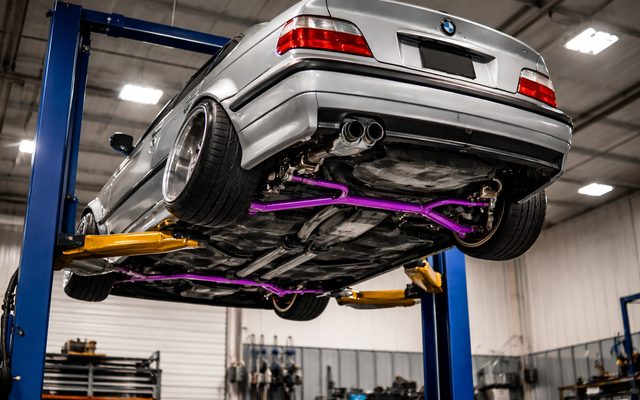
In the demanding arena of today's serious drifting, success is far more than purely a product of raw horsepower or behind-the-wheel aggression. Rather, it is now a intricate science which necessitates a painstaking fusion of picking a inherently capable vehicle platform, equipping it with the highest-quality drift-spec components, and, most essentially, comprehending its live performance on the track through sophisticated vehicle dynamics analysis tools. This exhaustive handbook will serve as your blueprint starting from the very first concept of a competition vehicle all the way to the last data-informed tweaks that turn a powerful car into a consistent winner. We will thoroughly explore the methodical process of vehicle alignment optimization, showing how a advanced vehicle dynamics tool like precise measurement hardware removes guesswork and offers unparalleled clarity into your chassis's actual dynamics.
The foundation of any exceptional drift car is, without question, the platform itself. Certain cars have achieved renowned reputation within the global oversteer community due to their inherent weight distribution, strong construction, and the immense range of aftermarket components available. Selecting the right starting point is the first and most crucial decision a builder will make. To illustrate, the BMW's E36 3 Series is universally acknowledged as among the finest balanced drift platforms of history. Its excellent balanced front-to-rear weight, combined with a rear-wheel-drive setup and robust straight-six powerplants, establishes a car that is simultaneously easy to handle for novices and incredibly capable in the possession of a professional pilot. The next step of this concept, the BMW E46 platform, improves on these qualities with a even more sophisticated chassis, increased track for greater confidence, and yet a greater degree of steering angle straight from the OEM. A distinct formidable option in the pro circuit is the Corvette C6.
This muscle-derived track weapon introduces a unique array of strengths to the sideways world, such as a lightweight alloy structure, a rear-mounted drivetrain component that contributes to an ideal weight distribution, and the immense torque of a large-displacement GM LS engine. This fusion makes it an complete force on track, able of initiating and holding long slides with apparently effortless application of throttle. For drivers desiring remarkable bang-for-the-buck, the 350Z model Nissan stands out as a prime choice. It comes from the manufacturer with a robust chassis, a effective original locking differential, and the free-revving VQ35DE motor that provides plenty of horsepower and torque for learning and advancing in the sport. Its successor, the Nissan Z34, offers more advancements in body strength, suspension design, and peak engine output, cementing its position as a popular selection among competitive drivers. Additional iconic cars that merit consideration encompass the nimble Wankel-engined FC generation RX-7, the ever-present Nissan S13 240SX, the V8-powered Ford Mustang SN95, the electronic-equipped BMW E90, and the compact yet unbelievably playful and instructive MX-5 Miata. Every single one of these cars offers a distinct set of characteristics, challenges, and capabilities, but they all have in common the fundamental ingredients essential to serve as a serious sliding vehicle.
However, picking the optimal platform is just the beginning. To access the complete capability of any of these vehicles, significant changes to the steering and suspension systems are absolutely non-negotiable. This is where the world of specialist aftermarket components becomes vital view. The most most game-changing modification for a serious drift car is the fitting of a high-performance drift angle kit. These engineered assemblies, like those developed by industry leaders like SLR Speed, are designed to dramatically increase the chassis's maximum turning lock. A factory street car is highly constrained in how far its steering tires can pivot, a engineering trade-off for public road driving. In sliding, conversely, maximum countersteering is constantly required to control and hold a angle. An steering kit replaces the stock uprights, tie rods, and potentially suspension arms with components that permit the front tires to attain degrees of turn beyond 70 or even 80 °, as opposed to a typical OEM limit of around 40 to 50 degs.
This vastly increased capability offers the operator with significantly greater control during a angle, allowing it to be considerably simpler to begin a slide, maintain it through a sweeping turn, and switch fluidly from one direction to another. The contrast in controllability is absolutely profound. Paired with a properly selected modification is the just as vital enhancement to the vehicle's suspension. Store-bought or even high-end road coilovers are just not engineered for the specific and brutal needs of sliding. A drift-spec pair of adjustable dampers is crucial. These specialized dampers have custom valving and spring stiffness that are tuned for the rapid weight transfer that is typical of sliding. When a pilot starts a drift, the chassis's mass is thrown rapidly to the front of the turn. Optimal drift-spec suspension handle this shift in a controllable way, allowing the chassis to settle rapidly and providing the operator precise feel through the steering wheel and cockpit. They furthermore provide exact tuning of ground clearance, shock absorber stiffness, and corner weighting, which are all key elements of fine-tuning the car's behavior to a given track or piloting approach. As a system, a high-quality drift angle kit and a correctly specified set of performance adjustable dampers form the undeniable mechanical base upon which all future optimization is based.
Once the essential hardware is in place, the following critical stage in the build is the detailed tuning of the chassis's alignment. This is the world of vehicle alignment optimization, a process that can seem intimidating to the uninitiated but is, in practice, the defining factor to converting a collection of capable pieces into a cohesive and controllable vehicle. The most critical element of alignment for oversteer is undoubtedly camber. Camber is the tilt of the wheel in relation to the perfectly straight axis when observed from the forward of the chassis. When the top of the wheel is tilted inward, this is known as negative camber. In sliding, negative camber on the front tires is widely used and is regarded as critical. The reason is intrinsically linked to tire contact.
When a car is turning at high angles, the body leans to the external of the bend. This lean makes the outside steering tire to diminish its optimal grip area with the track surface. By applying inward lean, the wheel is pre-tilted to compensate for this tilt. As the car leans into the corner, the outside front tire becomes more upright against the track, optimizing its vehicle dynamics tool bite at the precise moment when it is needed most for directional command. Usually, front adjustments for a competition drift car range from approximately -3 degrees to as much as -5 degrees or even greater, contingent on the specifics of the chassis setup, tire choice, and operator style. The rear axle tires also coilover setup tips employ inward lean, but the angles are usually less and less aggressive than the front axle. Excessive camber at the rear can cause the vehicle to overly loose and challenging to control on throttle input, as it diminishes the effective grip area of the driven tires during straight-line power delivery. Therefore, rear camber settings are often in the vicinity of -1 degree to -3 degrees, achieving a careful balance between offering adequate lateral bite to help in starting and sustaining the drift while also keeping effective grip for acceleration the bend. Camber is merely one part of the broader alignment equation, which furthermore involves toe, caster angle, and suspension-induced steering adjustment.
Toe is the orientation of the tires when viewed from the top. Inward toe means the leading edges of the tires are nearer together than the trailing edges, while negative toe means the reverse. For sliding, a small amount of front toe-out is often employed to quicken the turn-in handling feel, making the chassis feel more responsive and willing to start a oversteer moment. Rear toe angle is usually set to neutral or a very small amount of inward toe to promote stability under acceleration. Caster is the frontwards or rearward angle of the steering axis when looked at from the side-on of the car. More caster angle improves self-centering and stability confidence, and it furthermore increases inward lean effect during cornering, which is highly beneficial. Setting these values is a intricate interaction where a modification to a single value can and will affect the others. The conventional process for tuning a car's suspension geometry for drifting has for a long time been a tedious process of experimentation and feeling. A driver or team would make a adjustment based on experience, run the vehicle on track, use the pilot's individual feel and comments, and then make another change. This cycle would continue over and over until the chassis felt "acceptable" or the available track period ran out. This methodology is not only incredibly slow in terms of hours and tires, fuel, and parts, but it is furthermore deeply flawed.
Human feel is a famously subjective metric, colored by many factors such as tiredness, varying track grip levels, weather, and simply the mood of the pilot on that specific run. What feels "loose" on one run might feel "pushing" on the next pass, leading to contradictory feedback and counterproductive adjustments. This long-standing limitation in car suspension tuning is exactly where state-of-the-art engineering tools has made its mark to transform the landscape.
The rise and integration of advanced drift telemetry software has introduced a radically different age for building and perfecting high-performance drift cars. These tools, exemplified by groundbreaking systems like modern telemetry hardware, work by directly capturing the live mechanical performance of the vehicle as it is operated on the course. In contrast to depending on driver feedback, these systems acquire measurable metrics on critical variables such as damper compression and extension, corner velocities, G-force loading, lock position, and accelerator and brake pedal position. This raw data stream is then processed by sophisticated applications that can plot and analyze the data in a clear format. For the first time ever, engineers and teams can visualize precisely what the chassis is doing at each point of a drift. This function transforms the whole chassis setup workflow. Imagine the specific task of setting the front axle negative camber for a particular chassis. As an alternative to introducing a change from -3 degrees to -3.5 degrees and then driving several passes to try and "perceive" a improvement, a vehicle dynamics tool can give immediate and clear data. The application can display in a chart how the suspension's loading is performing during the key stages of a angle: turn-in, mid-corner, and transition. It can demonstrate if the present camber setting is enabling the loaded tire to maintain ideal contact or if the rubber is working inefficiently on its outside edge.
The tool can subsequently suggest fact-based recommendations for change. Perhaps the information shows that the tire is even overloading its sidewall at -3.5 degrees of camber, implying that even more angle, say -4 degrees, might be warranted. On the other hand, the data might show that the tread is not coming up to optimal operating temp or that the inside edge is degrading unevenly, which could point to that there is overly aggressive angle and a slight lessening back to -3.2 degrees would be more optimal. This level of granularity and useful analysis was literally impossible in the time of pure manual tuning.
The benefit of using a dedicated drift telemetry system extends much further than merely setting camber. It becomes an essential coilover setup tips that is tailored to your specific vehicle. When setting the damping clickers on your suspension, instead of depending on vague guidelines or mimicking another driver's setup, you can use the telemetry to see how the vehicle is behaving in response to your adjustments. The application can show the wheel movement data over a lap, revealing if the shocks are managing the weight transfer optimally or if they are allowing the vehicle to become unsettled too much after a direction change. It can assist in diagnosing issues like hitting the bump stops or excessive extension, permitting you to introduce data-backed adjustments to spring preload, rebound/compression settings, or ride height. This approach translates equally to the intricate art of corner balancing. Beyond camber, the software can give analysis into how changes to toe settings and caster are affecting the car's balance during specific parts of a drift. For example, it can assist you to find the optimal amount of front negative toe for your individual angle kit geometry and competition technique by analyzing the quickness of initial response and the predictability of the vehicle at full lock. This transforms the system an exceptionally effective vehicle dynamics manual that is dynamically informed by the real-world behavior of your personal car on the track. It shifts the entire project from a subjective skill into a scientific development process.
Furthermore, the value of a platform like data acquisition is not at all limited to expert tuners with extensive resources. For the grassroots driver, it functions as an powerful force multiplier. It in essence gives the tuner with the knowledge of a expert dynamics engineer without requiring the associated overhead. It speeds up the learning curve by giving clear solutions to challenges that would traditionally take countless track days of experience to understand. A builder can see how their particular vehicle reacts to specific adjustments, gaining a more profound knowledge of vehicle dynamics in the journey. It also makes accessible advanced chassis dynamics principles, enabling anyone with the ambition to optimize their vehicle to accomplish it in a systematic and car suspension tuning effective way. This is particularly important in a discipline like oversteer competition, where engineering knowledge has historically been a highly secretive asset among elite drivers. Today, that power can be in the toolkit of every motivated driver.
In the final analysis, the journey to engineering and dialing in the ultimate championship-contending sliding vehicle is a multi-stage project that smoothly integrates proven engineering wisdom with cutting-edge digital tools. It starts with the strategic selection of a capable chassis, then enhanced by the installation of critical performance components like high-performance drift angle kits and correctly valved drift-spec suspension units. The process then progresses into the precision phase of chassis dynamics adjustment, where values like camber angle, toe, and caster angle are carefully configured to match the chassis's upgraded hardware and the driver's individual style. Ultimately, and what really differentiates the contemporary process from the traditional methods, is the integration of a advanced suspension tuning application. This tool eliminates the uncertainty and trial and error of only subjective tuning by delivering quantifiable, live telemetry on how the chassis is really performing. It serves as an indispensable suspension tuning tool, a comprehensive alignment optimization handbook, and a comprehensive performance analyzer. Together, this integrated philosophy guarantees that every element of the drift car—from the pick of the chassis to the last click on the coilover—is optimized for peak performance on the track. It signifies the full progression of the discipline of oversteer driving, connecting raw driving skill with data-informed chassis dynamics to build the ultimate competitive vehicles possible.